Let's do some uncomfortable math. Under the retail collective agreement in force in October 2026, an employee earns between ARS 1.3 and 1.4 million gross per month. Add employer contributions, the mid-year bonus and the health-insurance contribution and the company pays about ARS 1.8 million: almost US$ 1,200 at the official exchange rate, and that is before workers' compensation insurance, vacation or attendance bonus.
This is not a complaint about salaries: we wish they were higher. It is a question about where the money goes. Many of those jobs are almost entirely taken up by the same things over and over: answering how much something costs for the tenth time, entering invoices, reminding people of appointments, chasing receipts. For that kind of work there is now the digital employee, also called a virtual employee or AI employee: an artificial intelligence assistant trained for one specific task, which works around the clock, never tires or forgets and, in our experience, costs about a third.
Retail job (collective agreement)≈ US$ 1,190
Digital employee (indicative)≈ US$ 400
Our own estimate at the official Banco Nación rate (ARS 1,540). Retail job: collective agreement CCT 130/75 salary plus employer contributions, health-insurance contribution and mid-year bonus; excludes workers' compensation, vacation and attendance bonus. Digital employee: WAIA's indicative figure ("about a third"); it varies with the task and its complexity.
The difference is around US$ 800 a month per position, almost US$ 10,000 a year. An SME with five positions like that leaves almost US$ 50,000 a year on the table.
What is a digital employee (or virtual employee)?
A digital employee is an artificial intelligence assistant trained with a company's rules, prices and information to do one specific task, every day and at any hour: answer WhatsApp queries, schedule appointments, enter and reconcile data, publish content. It is not a menu chatbot ("press 1 for..."): it understands what the person writes, uses the business's data and hands the case to a person when needed.
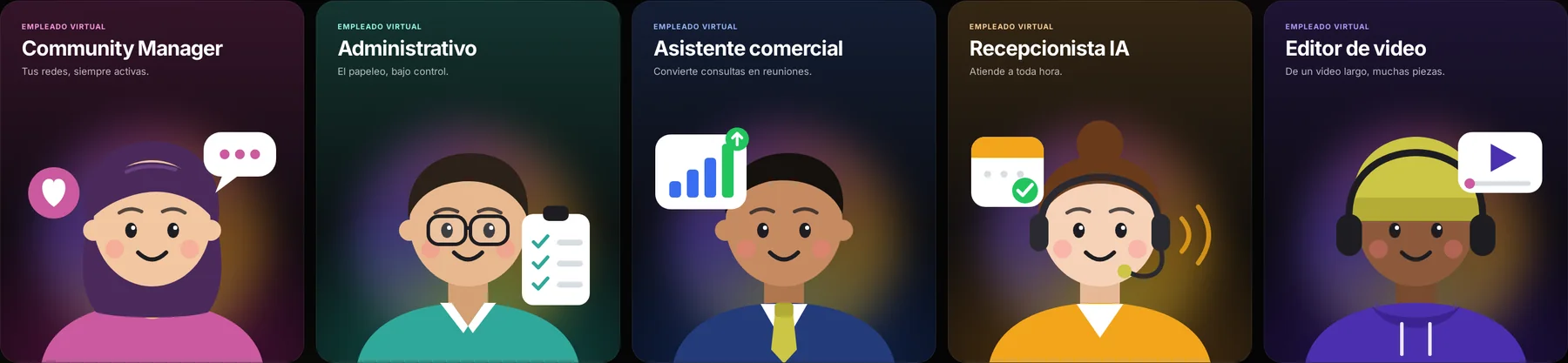
Today it can cover five roles:
- Administrative assistant: enters and sorts invoices and receipts, tracks collections and payments, reminds those who are late and flags when something doesn't add up.
- Sales assistant: answers queries in seconds, spots who to prioritize, books meetings and follows up until the close.
- AI receptionist: answers calls and WhatsApp, gives opening hours, prices and requirements, books and reschedules appointments, and hands off to a person when needed.
- Community manager: builds the calendar and the copy of every post, answers comments and messages and keeps the brand's tone.
- Video editor: cuts clips from long videos, adds subtitles and prepares them in formats for reels, shorts and stories.
Digital employee vs. human employee: the no-nonsense comparison
| Criterion | Human employee (retail, collective agreement) | Digital employee |
|---|---|---|
| Monthly cost to the company | ≈ US$ 1,190 | ≈ US$ 400 (indicative) |
| Availability | Agreement working hours | 24 hours, 7 days a week |
| Queries at once | One at a time | Many simultaneously |
| Repetitive task | Does it, with the normal variation of a working day | Does it the same way the first and the thousandth time |
| Judgment, empathy and negotiation | Their strength | Limited: hands off to a person |
| Measurement | Hard to measure task by task | Every conversation is recorded and can be measured |
It is not one against the other: the digital employee takes the repetitive work and the person keeps what calls for judgment, empathy and negotiation. What makes no sense is paying for a whole position to do the first.
Does it really perform better?
The available data says yes, with one condition. In a study of more than 5,000 customer-support agents, published in the Quarterly Journal of Economics, an AI assistant raised productivity by 14%, and by 34% among the least experienced. In a Harvard and BCG experiment with 758 consultants, those who used GPT-4 completed 12% more tasks and did them 25% faster. Klarna reported that in its first month its assistant handled 2.3 million conversations, the work of 700 agents, and cut resolution time from 11 minutes to under 2. And Gartner projects that by 2029 AI will resolve 80% of common customer-service issues on its own, with 30% lower operating costs.
The condition: it is not good for everything. On the task that fell outside its reach, consultants using GPT-4 got it right between 60% and 71% of the time, against 84% for those working without it. And Klarna itself admitted in 2025 that it had gone "too far" and went back to hiring people for the cases that matter. AI that works doesn't replace human judgment: it frees it from the repetitive.
What is happening at home
In the Greater Rosario industrial belt, between Puerto San Martín and Villa Gobernador Gálvez, a large part of Argentina's foreign trade moves: according to a Santa Fe government assessment, the ports in the area handle about 78% of the country's shipments of grain, meal, oil and biodiesel. Around them orbit metalworking, logistics and service SMEs, with spreadsheets, delivery notes, quotes and customer queries that repeat every single day.
And yet the first national survey of AI adoption in SMEs shows how far there is to go:
41.6%of the industrial and software SMEs surveyed already use some AI tool
35%in metalworking, against about 85% in software and IT services
57%of those that use it don't measure what result it gives them
Source: Torcuato Di Tella University, Fundar and Observatorio PyME, 402 industrial and software firms with 10 to 249 employees, November-December 2025.
What stands out is how they use it: almost eight in ten apply it mainly to writing content. MIT called it the "GenAI divide": 95% of pilots don't move a single number on the balance sheet, because the money goes to showcase projects instead of automating the back-office work, which is where the return is (we covered it in this analysis). We are using artificial intelligence to write emails and leaving untouched the spreadsheet where the money goes.
In Funes, 124 new businesses registered against 35 closures in 2025, according to the local Commerce Secretariat: there is plenty of entrepreneurial energy. What can't happen is opening a business with the cost structure of twenty years ago, in a province that, according to Apyme Rosario, lost almost 3,000 SMEs with up to 100 workers since December 2023. When margins are that thin, every fixed cost that can stop being fixed matters.
Which repetitive tasks to delegate first
The rule is simple: a repetitive, narrow, measurable task. If a person does it the same way every day, it is a candidate. Some typical examples, by sector:
- Retail and services (Funes, Rosario): price, stock and opening-hours queries on WhatsApp, appointments and reminders, and follow-up on quotes that went unanswered.
- Industry and metalworking (industrial belt): customer and supplier queries, quotes, tracking of orders and delivery notes ("has my order shipped yet?") and repetitive data entry.
- Logistics and foreign trade: status updates on an operation, documentation reminders and follow-up queries.
- Administration in any SME: invoice entry, reconciliations and reminders for overdue payments.
These are typical tasks for each sector, not a list of what we have already implemented in each one.
What not having a digital employee costs: the math in three steps
- Count the hours: add up the hours per week your team spends on repetitive tasks (the same queries, data entry, reminders).
- Put a price on the hour: a retail job at ≈ US$ 1,190 a month, with about 180 effective working hours a month (net of holidays, vacation and leave), costs ≈ US$ 6.60 an hour.
- Multiply: 20 hours a week is about 87 hours a month, ≈ US$ 570 a month and almost US$ 7,000 a year.
That is the math for a single position, done with round numbers. With your real hours you get your number, and it is what you pay today for not having a digital employee.
Quick replies: the six excuses for not automating
The most common objections, and what to answer:
“My customers want to talk to a person.”
Quick reply: And they will. The digital employee handles the repetitive and hands what matters to a person: that is the design, not a flaw. Besides, 93% of Argentine internet users are on WhatsApp, and that is where they are already writing. What bothers people most is waiting hours for an answer that could arrive in seconds.
“It will make mistakes.”
Quick reply: Sure, like anyone on a Friday at six in the evening. That is why the task is narrowed, measured and supervised. In the Harvard and BCG experiment, outside what AI does well the consultants got it right between 60% and 71% of the time against 84%: the lesson isn't “don't use AI”, it's “use it where it performs”.
“It's expensive, I don't have the budget.”
Quick reply: Look at the math above: you are already paying for those hours. In our experience, a digital employee costs about a third of a retail job, and you start with one single task.
“That's for big companies.”
Quick reply: 41.6% of the industrial and software SMEs surveyed already use AI. You don't need a technology department: you start with WhatsApp, the channel you already use.
“It will leave my people without a job.”
Quick reply: 91% of the surveyed firms that adopted AI did not cut staff. The idea is different: your people sell, solve the hard problems and look after the customer who matters, instead of answering the same thing twenty times a day.
“My company is a mess, it can't be done.”
Quick reply: The mess is paid for every day, and AI doesn't fix it on its own: MIT points out that pilots fail more because of how they fit into real work than because of the technology. That is why you start with a narrow, measurable task, and sorting out that task is already a gain.
The results are not lab results
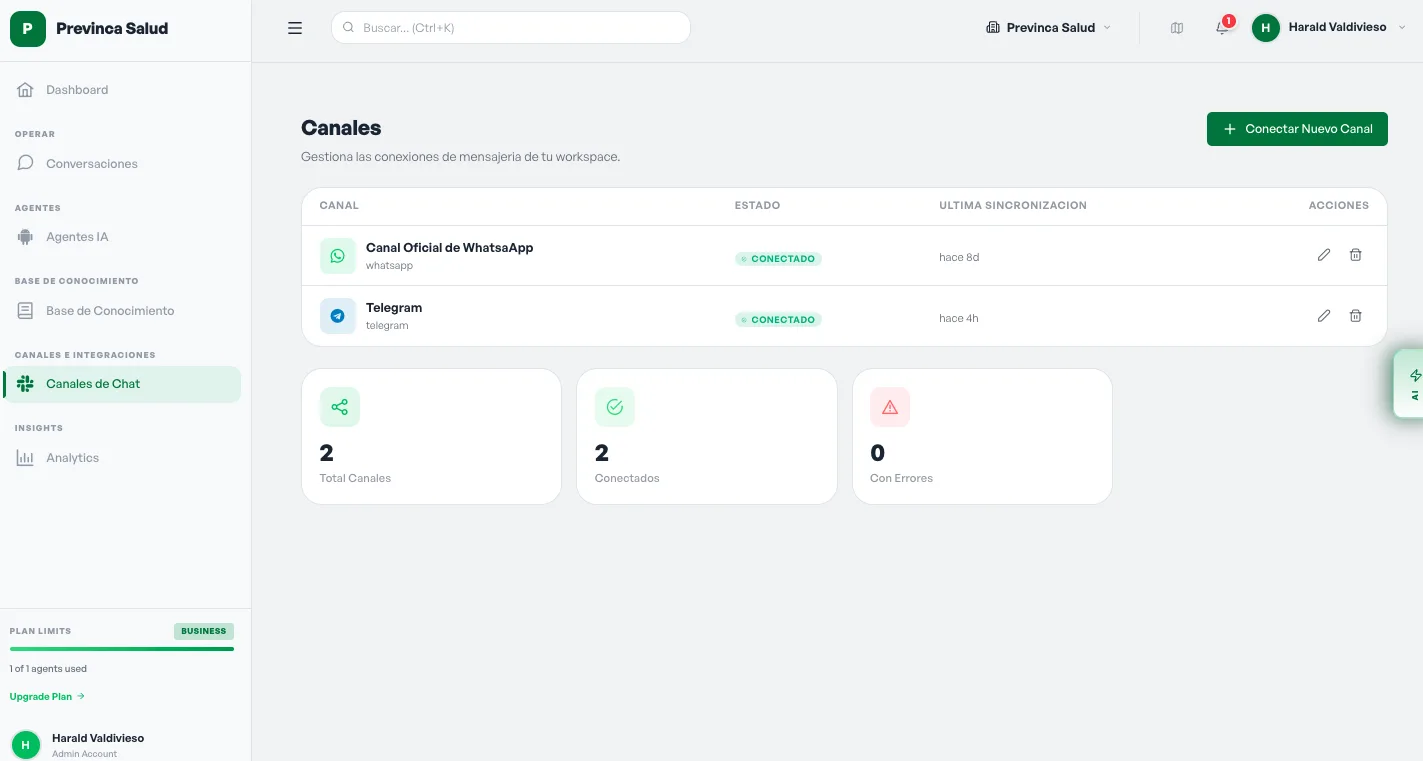
- Previnca (San Lorenzo): 40% fewer call-center queries with a WhatsApp assistant. See the case.
- RiskRator: onboarding a bank customer went from one week to 2 hours. See the case.
- Neumáticos Verona: recovers 25% of abandoned carts with a WhatsApp bot. See the case.
The real risk is not trying: it is trying without process or measurement. That is why it makes sense to start with a narrow, repetitive, measurable task, with a person supervising.
Nobody is asking to fire anyone. It is about no longer paying for a full position to do tasks that don't need a person, and putting those people where the business grows: selling, handling the difficult customer, thinking. A budget is not protected by spending less: it is protected by losing less. And today the most expensive thing an SME in Rosario, Funes or the industrial belt can do is keep waiting.
If you want to go deeper, also read Virtual employees in Argentina: real benefits and how a software factory works.
Sources and data
- Retail workers' salary scales (CCT 130/75), October 2026, and the Banco Nación official exchange rate for October 8, 2026 (ARS 1,540 sell). The cost to the employer is our own estimate.
- Brynjolfsson, Li and Raymond, Generative AI at Work (NBER; Quarterly Journal of Economics, 2025).
- Dell'Acqua et al., Navigating the Jagged Technological Frontier (Harvard Business School).
- Klarna (figures reported by the company itself, February 2024) and Gartner, March 2025 projection.
- National Survey on AI Adoption in Argentine SMEs: it covers industrial and software firms, not every SME in the country.
- Santa Fe government assessment (December 2023), InfoFunes and El Ciudadano (Apyme Rosario).
- WhatsApp: 93% of Argentine internet users aged 16 or older, Digital 2025 (We Are Social and Meltwater).
